

A Beginner’s Guide to Being Better on Camera Without Becoming Insufferable
The simple reframe that helps you sound more honest, relaxed, and like yourself.

A note before we begin: this essay is technically about camera presence, but really it’s about something most of us struggle with: expressing yourself honestly in the moment without performing.
If being on camera isn’t your thing, read this through the lens of any moment where you want to feel more like yourself and less like you’re auditioning i.e. a meeting, a conversation, a first date, a room full of people who make you suddenly forget how hands work.
It applies.
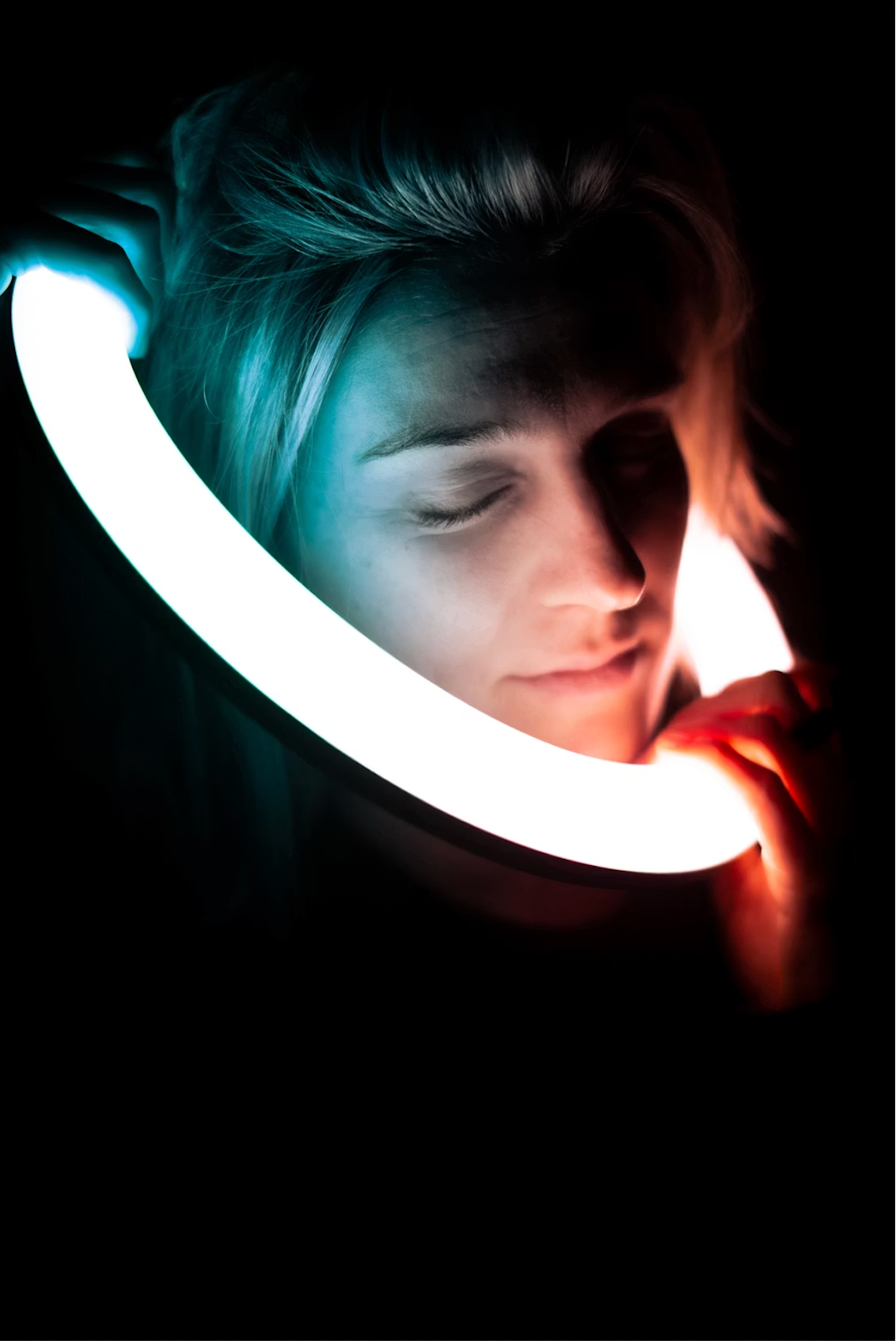
That moment right after you hit record is bizarre.
You’re not doing anything yet. Just sitting in the tiny silence before you speak while that cold glassy eye stares back at you. You’re waiting for an ‘in’.
Maybe you’ve done a few Substack Lives. Or recorded a handful of videos. Enough to know you can technically do this.
But knowing how to press record is very different from feeling like yourself on camera.
So you watch the playback and reach for the digital scissors.
Ten cuts. Fifteen. Thirty. A hundred tiny slices in a four-minute video. The ums. The weird pause. The moment your face did something you did not authorize.
You piece it back together until it’s okay. Watchable.
But not quite you.
I know this feeling well. There’s not enough digital touch-up in the world to fix the experience of crawling out of your own skin on camera… or in any life moment, really.
So I want to offer you something that helped me. Not a technique, exactly. A reframe.
Because I don’t think the problem is your lighting, your microphone, or your compulsive need to say “so” and “like” at the beginning of every sentence.
The problem is who you think you’re talking to.
The imaginary crowd
The second we hit record, or walk into an interview, most of us conjure a fake audience. An amalgamation of people with arms crossed, bored expressions, vaguely disappointed in us before we’ve even opened our mouths.
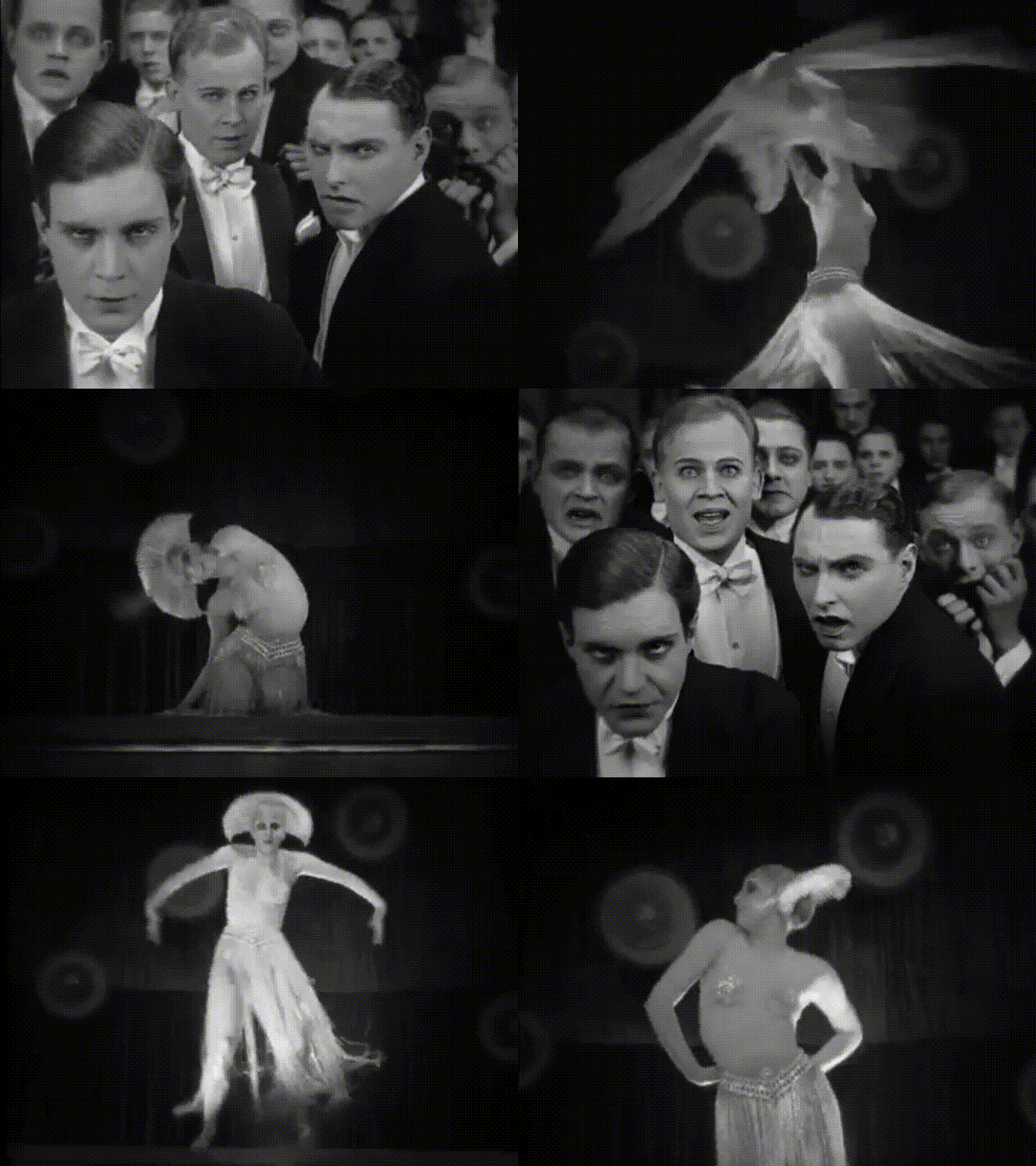
We’ve constructed this phantom crowd from every fear we’ve ever had about being too much, not enough, too earnest, too weird, not smart enough, and too awkward in a body we suddenly remember people can see.
Writers, I think, feel this especially dramatically. We came to writing partly because it gives us control. We get to draft and delete and resurrect and delete again.
I google “synonym” and edit sentences over and over until I arrive at something true on the page. The written word has always been a place for a long private negotiation with myself. I was the person who drafted out conversations with the boy I liked before calling him. Yes, I used a script.
The camera feels immediate by comparison. Exposure before editing or before we’ve decided how much to reveal.
So we brace and hold back. We edit ourselves. Or worse: we perform. We become a plastic, shiny version of ourselves. Our voice rises into stilted professionalism...(barf). We start saying things we would never say to a friend. We become, in a word, stiff: trapped in a cardboard-boxy version of ourselves.
Here’s the thing that has taken me a lifetime to understand:
the judgmental crowd in your mind isn’t real…but your body keeps responding to it as though it is.
The Slurpee incident
Many years ago, when I was a new actor, one of my first auditions required me to bump into a kid and spill a Slurpee all over myself. Simple scene. I rehearsed it until it was dead. By the time I got into the room, I was so deep in my own head (so busy performing the performance) that when I bumped into the imaginary child, in my self-loathing, I accidentally said the F-word.

It wasn’t a bold creative choice. It was my inner critic dropping the F-bomb in a room of producers and a director.
The room laughed. For one second, they thought I’d meant to do it. They thought: oh, there she is.
They were right. That was the realest moment in the audition. Swearing at an imaginary child isn’t a technique I’d recommend (please don’t), but it was the moment my true self broke through the performance. What they responded to wasn’t anything I planned. It was aliveness. The genuine thing that happens when you stop trying to control how you’re perceived and just... exist.
What we want, in video, is that same quality. But without the shame spiral.
One person, not everyone
Here is the shift that changed everything for me: I stopped imagining an audience. I imagined one person.
You’re not talking to your whole readership. One specific, trusted person who thinks you’re cool, who doesn’t interrupt, who genuinely wants to hear what you have to say. A friend. A reader you’ve corresponded with. Someone who already gets you.
This is not just a nice metaphor. This is a nervous system intervention. When you imagine speaking to “everyone,” your body hears danger. I know when I’m in this zone because I see a whole crowd of people sitting in bleachers. Everyone is there: my college roommate, my mother’s friend Sandra, and at least one guy named Chad or Brad. But when I imagine one trusted friend? My body gets it. It’s just a conversation, not a performance in a high school gymnasium.
Before you record, be deliberate about this. Take a breath. Maybe make tea. London fog is my choice. Think of your one person. I think of my hilarious girlfriend. She puts me at ease. I can say the most ridiculous, simpleton thing and she will howl with laughter.
Yes, let yourself actually feel the warmth and freedom of that.
You are talking to someone who already likes you.
Your spoken voice already knows how to do this
Writers often feel like video is asking them to become someone else: a different, more extroverted, more charismatic version of themselves. Someone who gestures naturally and doesn’t lose their train of thought mid-sentence. But let me tell you something: Meryl Streep loses her train of thought all the time. She just finds her way back, and finding her way back is actually part of what we love to watch her do. She doesn’t apologize for being in the middle of a thought.
The camera is not asking you to be smoothed out. The camera is asking your spoken voice to catch up to the voice that already exists on the page.
You already know how to be truthful. You do it in your journal, your drafts, your voice memos, the paragraph you cut because it felt too raw…and then realized later it was the most truthful part of the whole thing. The camera wants to hear your real writing voice, just spoken out loud.
Three things to try before you hit publish
1. Record with nothing at stake.
Hit record with zero intention of publishing it. Just to feel what it’s like to let your real thoughts have air. Say the thing that feels too specific, that weird theory you’d only tell your partner or a close friend. That’s usually where the good stuff is hiding.
2. Record freely, edit intentionally
You don’t have to post any of it. Let yourself say more than you’ll ever share. A lot of what comes out first is just roughage. The verbal compost pile before the actual thought appears.
Give yourself the dignity of a half-baked, messy first pass. Some stories aren’t ready yet, and as you produce more, you’ll develop an eye and ear for that.
3. Listen back like it isn’t you
There’s something powerful about hearing your own voice say something true before anyone else does. Even if you cut it. Even if it never leaves your phone.
The recording itself is part of the practice: learning what you actually think, by listening to yourself the way you wish someone else would listen to you.
Before I make the guide, I’m curious:
On watching yourself back
Here’s the part I wish someone had told me sooner: you don’t have to like watching yourself right away. But you must stop treating your discomfort as evidence.
Discomfort doesn’t mean the video is bad.
It doesn’t mean you’re awkward or unwatchable. It usually means you are seeing yourself without the protective blur of performance, and your nervous system is going, absolutely not, ma’am.
Let it have its little tantrum…and then watch again.
Look for the moment you forgot to manage yourself. You might see that moment your face softened or you paused because you were actually thinking instead of auditioning for the role of Person With Deep Thoughts. Look for the moment you sounded more alive.
That’s the part to keep.
If being on camera makes you want to leave your body
I’m putting together an affordable beginner’s guide on camera presence — the stuff I wish someone had told me after 16 years of auditioning, freezing, overthinking, and eventually learning how to feel like myself in front of a lens.
If that’s something you’d want, let me know in the comments. I’d especially love to know what part of being on camera makes you want to crawl directly into the drywall.
And if you want more of this kind of thing in video form, I’m over on YouTube at Wannabe Wisdom Diaries — and on my hypnotherapy/meditation channel, Drift & Deepen — practicing what I preach.
— With love & a little rebellion,
Ashley ❤️

My life has been on the recording end…the filming, digital capture…seldom the one being photographed or recorded (great admiration for those who know and do it well) so this is both fascinating and alien!
👽
Your descriptions and advice, though, are simply brilliant!
Most of what I photographed was reality (me just being a visual recorder, hopefully invisible in the room or on the playing field). When I did have to occasionally photograph a model or a performing artist, the very best ones adhered to the script you have presented here.
Somehow they mastered the art of manufacturing their true self…though oftentimes it was through the reflection of someone else they were portraying or a style or certain vibe needing to be communicated.
Rambling (as usual) to simply say…such incredible direction and advice, Ashley!
You make the viewing experience, information delivery real and sincere, reflecting deeper meanings of truth and valued human expression.
ps-that black and white video was absolutely hilarious. My 9-year-old inner child pictured you leading a yoga class EXACTLY like that! Minus the really creepy audience!!-)
Happy Tuesday, Ashley!
✨☘️📽️
This happens in virtual presentations or group calls too. The camera lies and says it's something unreal to be feared, instead of just talking to it like a person. Everything in here is really sound, human advice.